 |
4 min read |
The Proof Slip
| Slip No. 001 | Tue 13 Oct 2026 |
|
 |
|
The rule
Before you automate anything, count it.
Every AI pitch arrives with a percentage. Almost none arrive with the number it came from: how many times a person touches the work today, and for how long.
I run operations at a law firm, and I was handed “figure out AI” too. The Proof Slip is the newsletter I wanted: one workflow, one number, one failure and one thing to try, for the people who run firms of 15 to 75 lawyers and the partners they answer to.
Issue one has no findings yet, on purpose. You cannot show what AI changed without a before, so this issue is about the before.
|
 01 01 |
On the books · The gist of ABA Formal Opinion 512
Bill the time spent, not the time the tool saved.
The ABA’s first formal opinion on generative AI (Formal Opinion 512, July 29, 2024) is still the clearest map for operations. The parts that land on your desk: lawyers need a reasonable understanding of the tools they use; before client information goes into a tool that can learn from it or share it, the opinion generally calls for the client’s informed consent, and boilerplate in an engagement letter is not enough; and an hourly bill reflects time actually spent, not time a tool saved. Learning a general-purpose tool is usually overhead, not a client charge.
That last point is the one to take to your managing partner. On an hourly matter, an hour a tool saves is an hour the firm no longer bills, unless someone decides how to price the work.
Florida’s Ethics Opinion 24-1 is one of several state opinions on the same ground. Read the source before you write policy from it; this is a summary, not legal advice.
|
|
 02 02 |
Built · Court notices, composite
The solid line is the person.
Every workflow we write up starts with the same drawing. Machine steps are dashed. The step where a person checks the work is solid, and that is the step we measure.
| Notice arrives | INBOX |
| |
| Notice read, deadline proposed, matter matched | AI |
| |
| Legal assistant confirms the date against the docket | HUMAN |
| |
| Calendar event created | SYSTEM |
The question to ask of every workflow like this: how long does the human check take, and does it shrink over time or stay fixed? If it never shrinks, the tool moved the work instead of removing it.
|
|
|
Term of the issue
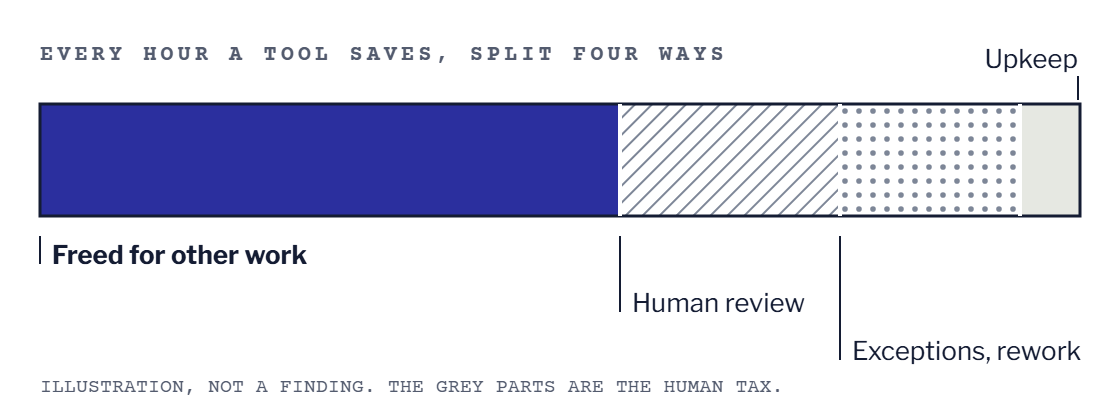
Human Tax
The time people spend checking, fixing and maintaining what the AI does. A tool can save real hours on paper and quietly hand a share of them back as checking. We report it on every workflow, because it is the part the demo leaves out.
|
 |
 03 03 |
Broke · A pattern to watch
Who owns your exceptions queue?
Tools that sort, match or extract send what they are unsure about to an exceptions queue. If nobody is named as its owner, the queue fills quietly, and what sits in it is the hard work: the notice with two case numbers, the invoice that matches no matter.
The fix costs nothing: before any tool goes live, write one name next to the exceptions queue and a time of day it gets cleared.
|
|
 |
 04 04 |
Measured
| 0 |
Findings so far.
First count:
December 2026 |
We publish no number without its receipt: what was counted, at how many firms, over what period, and by whom. The first count is the 2026 Legal AI Operations Pulse, a 12-minute survey for administrators at 15 to 75 lawyer firms: who owns AI at the firm, who checks its output, what anyone measures, and whether pricing has changed. Results go to subscribers first in December, labeled with how many firms answered.
|
|
|
Reply poll · results in Slip No. 002
How many people touch a court notice at your firm before it is calendared?
Tap an answer and press send. It comes to me as a reply, not to a tracker.
|
 05 05 |
Try this week
Count one workflow by hand.
Pick one workflow: the one a vendor is pitching you, or the one people complain about most (incoming mail, new matter intake or court notices). Hand this card to the person who handles it. For the next ten items, they make a mark each time anyone opens, edits, forwards or approves one, and jot the hands-on minutes. Write the date and who counted at the top. Ten items usually takes a week or two.
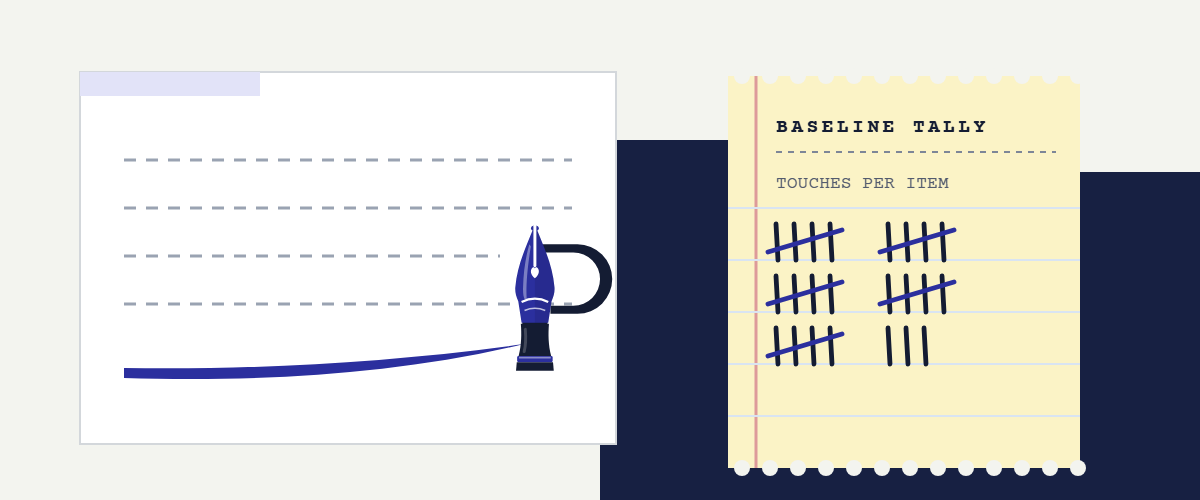
That is your baseline: the number every vendor percentage leaves out.
|
|
|
Forward this to your managing partner
Item 01 is the one to read together. On hourly matters, the time a tool saves is time the firm stops billing, unless someone decides how to price the work. Ten minutes on that now is cheaper than finding it on a realization report.
|
|
|
Reply with your count. I read every reply, and with your permission it goes into the Pulse with your firm’s name removed.
Next, in Slip No. 002: what you told me about court notices.
Until the next one,
Randy
|

|
|
| Numbers without a receipt | 0 |
|
|
You’re getting The Proof Slip because you signed up at proveupai.com. Forwarded this? Subscribe free.
Written by Randy Cloud, a law firm administrator, for administrators and operations leads at 15 to 75 lawyer firms. Examples are composites or my own experience, never a client’s or a firm’s data. Not legal advice.
|
|